Showing posts with label Temple. Show all posts

Sunday, April 17, 2022

Pure Ephraimite, AmIRight?

Brigham Young famously described Joseph Smith as "a pure Ephraimite." Likewise it is emphasized in the Book of Mormon itself that Joseph Smith is from Joseph of old (coming through Ephraim, as must needs be every president of the Church). This is a critical piece to the Ezekiel 37 prophecy, which describes a stick of Judah (Bible) and stick of Ephraim (Book of Mormon) coming together as scripture. 

There's just one problem. 

Joseph Smith Jr. was most likely not Jewish. Instead he was assuredly Irish. Northwest Irish to be exact.

But that's okay, because Ephraim wasn't always considered Jewish either. He was born of an Egyptian mother (Asenath) and he, along with his brother, Manasseh, had to be adopted into the 12 Tribes by their grandfather, Israel. His life among the patriarchs would be marked by excellence, as well as intense jealousy towards his uncle, Judah. 

To me, it would be poetic if God chose a gentile like Joseph Smith to restore a church for the ultimate gathering of Israel as a modern Ephraim, by blessing (not breeding) him into the fold of the chosen people he had long envied and tried to imitate. --Even through seer stones.

Let's talk about 3 different types of seer stones. Because this is not just about interesting genealogy (or lack thereof). I want to get to claims of power, authority, seership, and presidency today, and with bloodline out of the picture that leaves us looking elsewhere. 
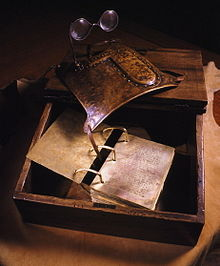

David A. Baird/
Historical Arts and Castings

The first type of seer stone is the spectacle-like device attached to the gold plates. This was meant to help Joseph Smith visualize and interpret the words engraved upon them by ancient hands. Because these spectacles are attached to a breastplate like temple priests of old, they are later referred to as an urim and thummim.  Traditionally, the urim and thummim would help priests perform cleromancy, i.e. determining God's will in a black and white, binary way. I imagine it would provide feedback as to whether man's interpretation was correct or not. At some point Joseph Smith decides he doesn't want to work only in this rigid way; he produces his own seer stone. The one that looks like a chocolate egg.

By Welden C. Andersen and Richard E. Turley Jr.


The chocolate-colored seer stone was something Joseph Smith had from when he was a young boy and fancied himself as having the powers of ancient Hebrew seers. There's a name for this kind of behavior, it's called Anglo Israelism. In other words, those who are from Northern European descent will believe --against all evidence to the contrary-- that they are literal heirs to the same blessings of Abraham, Isaac, and Jacob. This includes claims to priesthood power, land possession, and succession. 

The amazing thing is that the chocolate seer stone seemed to work. Joseph Smith produced The Book of Mormon with it. Later, when he comes across Egyptian papyrus, Joseph Smith uses another stone (a white one) to produce The Book of Abraham. We are starting to understand now that the chocolate-colored and white stones were likely not used for historical translations, but rather inspiration to produce scripture that deepens our knowledge of God.  

I have a testimony of The Book of Abraham. By extension, I believe those seer stones worked, not because Joseph Smith has the blood of Ephraim pumping through him, but because God blessed him to use those stones for enlightenment as He did with the Brother of Jared. This ability to act as seer further established Joseph Smith's authority as head of the restored Church. 

And then he was murdered without a succession plan.

It seems unthinkable that after all that effort to restore the Church of Jesus Christ, a framework for how it should continue was not solidified. And yet there it was, a succession crisis lasting 6 months! Thankfully the doctrine of having an established presidency with keys was already in place, but who should combine those keys and take on the mantel of president, prophet, and seer was up for serious debate and produced several factions in that time. 

Ultimately Brigham Young took the reins of the Church of Jesus Christ of Latter-day Saints, but not since his predecessor do we see presidents of the Church using seer stones to establish doctrine and scripture. And yet we know the Church held on to the seer stone(s) because it was able to produce this item recently for exhibition

This is because, I believe, those stones serve as a type of "budded rod." Please allow me to explain.

The "budded rod" is described in the Old Testament as proof that Aaron and his sons should lead the Israelites. The parallel to the latter-day succession crisis is astounding. In both cases each of "The Twelve" believe they are next in line for power and authority. In Numbers 16 we learn that God commands the 12 to lay out their staffs (AKA rods) and return in the morning. The next day Aaron's staff has bloomed and has produced literal fruit (almonds). That secures his place as leader, and the rod's place in the Ark of the Covenant, next to the gold pot of manna, and the 10 Commandments. What was Brigham Young's "budded rod"? I surmise that it was the seer stone, which had produced the fruit of The Book of Mormon and was handed over to him by Oliver Cowdery

Brigham Young and his successors would likely deny it. He wanted it known that his authority lie in in his proximity to Joseph Smith AND being a literal descendant of Israel, like so many past presidents of the Church purported to be since. But a few things point against lineage being the actual, literal reason. First, we have modern hindsight to inform us that LDS presidents were mostly Northern European by DNA. Second, Brigham Young held on to the stone despite never using it --to our knowledge-- to produce scripture. Third, this could be coincidental, the box the stone was kept in was adorned with a rose blooming from its bud.

I need to take you a bit deeper into this symbolism if we're going to discuss applications for today. If we think the seer stone is a type of budded rod, then I imagine gold pot of manna is represented in our time by the new and everlasting covenants revealed to us, and the tablets are the scriptures by which we'll be judged. Just like in the days of old, the Ark of the Covenant is the outward representation of a people united and led by God. It also cements the authority of our doctrine. 

The imagery of the gold plates providing mana to our souls today is very beautiful. Let us not forget the plates were not the only things given to Joseph Smith by the angel, Moroni. He also presented the Sword of Laban and the Liahona. I think we tend to take that in as a neat factoid, and evidence that the events recorded in the Book of Mormon really did happen. While they certainly served that purpose, I have come to believe they were emblems of the Church Head and Body. Of Judgement and Mercy. Even of Joseph and Emma. If we combine these elements, it creates a figurative Mercy Seat atop of the Ark. I also interpret them as a warning: Lose your way and you will lose your life. 

Woman as the compass or Liahona is not an original thought I have. The scriptures and temple are teeming with this connection. And while I am more drawn to symbolism than early Church history, I do know that when Joseph Smith introduced polygamy Emma Smith became withdrawn, Joseph was murdered, and Emma --who had been charged to discern truth from error-- ceased to journey with Brigham Young. Since that time it seems the modern Ark of the Covenant went West, separating itself from the Mercy Seat, leaving a space filled with enmity between the men leading this Church and the outspoken women who ask them to redirect. 

Enmity might seem like a strong word, but I don't know how else to describe the response Brigham Young and his successors had after Emma stayed put. The words of the temple were changed so that women no longer received blessing unto God, but their husbands instead. The Relief Society became an auxiliary organization, instead of part of the "kingdom of priests." Further light about Heavenly Mother was stunted or blocked. And much more in the era of Correlation. This is life without a Mercy Seat, if you ask me. 

I wish to emphasize two things here. First, if you've read this far, thank you. Second, the new figurative Ark established Brigham Young as the one who should succeed Joseph Smith, and that authority lives on through our current structure utilizing the laying on of hands. I still can (and do) sustain current Church leaders in their roles because they are legitimately assigned to them. The only insight I have carved out for myself is that this legitimacy isn't rooted in Ephraimite blood, but rather a stone. This view further underscores my interpretation of Church leaders as the "wild branches" in Jacob 5 who are keeping this Gospel alive despite simultaneously bringing it to its knees (e.g. here, here). 

As Church authority lives on hand to head, remember too that Emma has a "lineage" of placing her hands on heads that are keeping up the work of discernment. And it is work. It would be much easier to simply take everything said over the pulpit as God's truth spoken by his Ephraimite messenger, and not challenge the messengers to produce tokens to validate. As Revelation puts it, straddling verses 11:19 & 12:1-2:

19 And the temple of God was opened in heaven, and there was seen in his temple the aark of his testament: and there were lightnings, and voices, and thunderings, and an earthquake, and great bhail.

aAnd there appeared a great wonder in heaven; a bwoman clothed with the sun, and the moon under her feet, and upon her head a crown of twelve stars:

And she being with achild cried, travailing in birth, and pained to be delivered.

Pained in delivering this ark, this Church and its proclamations in the latter-days. I don't know about you, but I feel that.  

Sunday, March 1, 2020

A Deep Dive into the Priesthood(s) of God

Okay, this is a doctrine-according-to-me post.

To start I'll need to list some pertinent definitions:

Office: a special duty, charge, or position conferred by an exercise of governmental authority and for a public purpose : a position of authority to exercise a public function and to receive whatever emoluments may belong to it (m-w.com)

Order: a group of people united in a formal way OR a special duty, charge, or position conferred by an exercise of governmental authority and for a public purpose : a position of authority to exercise a public function and to receive whatever emoluments may belong to it (m-w.com)

Now to tackle this question: What's the difference between the Aaronic and Levitical Priesthoods? IS there any difference?

Yes, there's a big difference that makes the promise that the Aaronic Priesthood will never again be taken from the earth a big deal (see D&C 13:1), and it's that the Aaronic Priesthood can be shared with any worthy male, even outside the House of Israel.


I know the above image is hard to see, but if you were to zoom in it shows the House of Israel setup where male involvement equals patrilineal priesthood and the female role centers on producing heirs to the covenant. Make note that to be a Levitical priest you didn't just have to be male, you had to be a Jewish woman's firstborn, have no blemish, and your priestly father must bless you before he dies. Later on the angels come down from heaven to take Aaron and his sons through the washing and anointing process so that the priesthood can be extended to all worthy literal sons of Aaron (Exodus 40:12). This, in essence, becomes Levitical Priesthood 2.0. When the Early Church is formed, all worthy males are given access to the Aaronic Priesthood as we know it now, but this practice is eventually killed off (literally and figuratively). The Restoration brings back the more accessible Aaronic Priesthood.

As the above relates to keys, I see it this way. The apostles of the Church each hold 3 keys, which are 1) The Gathering of Israel, 2) the Abrahamic Covenant, and 3) Sealing power. Gathering of Israel is inherently female (you need to be born of a Jewish mother). Abrahamic Covenant is inherently male (your father must be a priest to receive His power). The sealing keys unite male and female for eternity. It's a nice triad. Note too that the office of Bishop rightfully belongs to a son of Aaron, and the gentile in that position is really just a seat warmer (see D&C 107:73). The keys to the Aaronic priesthood are for the outward ordinances (e.g. repentance, baptism), as well as ministering angels. The latter makes sense because the Aaronic Priesthood was initiated by actual angels descending to earth to minister to Aaron and his sons when the lower law (i.e. The Ten Commandments) were given.

Now let's talk Melchizedek Priesthood. It holds the keys to the spiritual things of the Church. You need it to confirm newly baptized members, to perform the sealing ordinance, and much more. We learn in D&C 107:4 that this priesthood is actually the Lord's priesthood, but to avoid overuse of his name it was called after Melchizedek who "was such a great high priest"  (see D&C 107:4 & 2).

Let's dive into this a bit more, though...

Because Melchizedek was notably NOT from the House of Israel.

Yeah, say that again. Melchizedek was NOT from the House of Israel. He was not an heir to the blessing of Abraham, Isaac, and Jacob. How do we know this? Because Abraham paid tithes to Melchizedek as a respected elder, meaning he was alive at the same time and not a descendant of Abraham. You know who else was outside of the House of Israel? All gentiles, and everyone else born before Abraham... Which includes Father Adam himself!

I point this out because it makes the Melchizedek Priesthood standout and gives hope to people who feel stifled within the four walls of the House of Israel (I'm looking at you, ladies). We then step back and see a priesthood that centers on Melchizedek, but begins with Adam and will ultimately end with Christ's return. This is some true Alpha - Omega power going on. It follows that the associated covenant would be new (Adam) and everlasting (Christ), and encompassing of all promises and blessings in and out of Abraham's posterity (i.e. House of Israel and beyond).

We learn in Moses 5&6 that Adam did not always have this great priesthood. It wasn't until he gave sacrifices that he was overcome by the Holy Ghost and baptized and confirmed by Him through the Spirit. (That fact, by the way, underscores why the Melchizedek Priesthood pertains to Spiritual matters.) From that time, all the sons of Adam had a birthright, but only the chosen few received his patriarchal blessing to join this holy order. (This is the same pattern for Abraham: sacrificing in similitude of the Father and Son, subsequent covenants and power from father to son.)

At the same time Adam entered into a priesthood covenant with the Lord, Eve also had the Holy Ghost come upon her (see Moses 5:11). Like Sarah, there was likely a key associated to the female component of this priesthood power. We don't know much about this except that trees are an important source of power and imagery relating to women (see this breakdown, and this one re: wisdom, James 1:5 and the Sacred Grove) and could be the token for priestess-hood. When we later read about Deborah the Prophetess we might think she's an anomaly in the House of Israel (i.e. a woman with power beyond procreation), but the more I study this I believe she was calling down a birthright as a Daughter of Eve (not Sarah), which was symbolized by her standing under a (date palm) tree.

Why have I dragged you down this rabbit hole? Why are we here in the priesthood weeds? For a couple of reasons. 1. We need to appreciate why priesthood restoration is a big deal for the rest of mankind and 2. methinks that the next chapter for women and priesthood power will come by filling in the details of the New and Everlasting Covenant. Whereas our greatest promise had been eternal power onto our husbands in the House of Israel (i.e. Aaronic, Levitical) and temporal authority in the offices thereof, the door is opening on the Melchizedek side for greater things in store. --Likely alongside the Adamic order. The Melchizedek key that relates to this is, "the key of the mysteries of the knowledge of God." (See D&C 84:19)

Predictions --because no pre-General Conference post is good without predictions-- we're going to take bigger steps toward gathering Israel, and in parallel the New and Everlasting Covenant will endow more women with more power in the temple... or perhaps in a grove of trees! (Why not, right?)

For what it's worth, I ended up in this doctrinal pursuit based on the prompts and clues President Nelson sent. So there's that. :)


Follow-up thought: The temple exists to take the sons of Aaron and make them the sons of Adam again. The temple exists to take the daughters of Eve and make them the daughters of Sarah, as well. 

Friday, April 5, 2019

See One, Do One, Teach One

Seems legit.


In the medical education system you start out as a medical student with no real power to execute orders, to a resident physician with the ability to make decisions, order tests, and prescribe medications ... so long as your full-fledged attending physician signs off on them. Finally, after board certification and completion of residency you're the real deal. You fly solo, all power and liability is on you.

In medicine we also have a "See one, do one, teach one" motto. When you're a medical student your job is to mostly observe what the doctors do. You might interview patients and write notes, but those things don't really count in the medical record. When you're a resident you have a bit of a safety net under you and this is when you start doing real things under supervision. By the time you're an attending physician the idea, in an academic setting, is to mostly teach the residents and medical students.

So why am I giving you the inside scoop on how the medical field works? It's because I suspect President Nelson, a physician surgeon, applied these academic principles to Church policy creation and that's how we got The Policy (re: gays and their children) and its reversal. Here's why:

In 2015 President Thomas S. Monson had severe dementia. The Church was being run (as is its policy in such cases) by the combination of presidency keys. We see Boyd K. Packer die in July 2015 and The Policy go into effect November 2015. What happened in the interim? Russel M. Nelson became Quorum (of the Apostles) President (QP). For context, everyone at this time knows Nelson is next in line to become prophet and Dallin H Oaks is positioned to become the next QP or higher (as would become the case).

If we view this in terms of:
apostle = med student
QP = resident
Prophet = attending physician

It would be no surprise then if Russell M. Nelson as QP jumped at the opportunity to use executive power for something that he could say was the will of the Lord, but policy only (i.e. not offical doctrine). This would be practice for the big role for which he was slated. And we know he moves quickly, wasting no time. The Policy would be his "do one."


When the Chief strikes down your order.


But what one man wants and what the Lord wants are often not the same thing.

What was supposed to happen is President Eyring and President Uchtdorf with new QP Nelson, along with the sustaining and authoritative power of the remaining apostles, were to turn their keys in confirmation of what was taught to them by the Spirit.

What I think happened is a couple of things. I think Eyring and Uchtdorf, having worked for some time now without a functional President of the Church, slipped into the mode of "I sustain our [future] prophet." They wanted him to get practice as QP and succeed. Also, let's be honest, they knew they were a geriatric heartbeat away from answering to President Nelson for the remainder of their ministry. I'm guessing that factored in.

suspect something went wrong right away. For starters, why focus on "the gay issue"? Especially right out of the gates? It seems like Nelson saw an obvious problem between homosexuality and Mormon Latter-day doctrine and wanted to fix it. I don't doubt he sought the will of the Lord, but it appears he landed on the side of legalism. And just who persuaded him to choose justice? Who likely pleaded for mercy instead (but ultimately relented)? I'll let you decide.*


*Worth a thousand words


In the end there needed to be apostolic consensus, but my guess is at least one presidency member drew near to The Policy with his lips for the sake of unity, but his heart (and key) were turned away from it. In contrast, I can see Nelson receiving guidance from someone who was close enough and practically there in terms of having presidential keys such that his input was valued more than it was worth. We see this happen from time to time in medicine, too. Senior resident and 4th year medical student start a surgical case without the attending surgeon and the patient bleeds out.

The patient in this case is everyone affected by The Policy. We can never say for sure how many LGBTQ members died by suicide as a result, but my gut and reasoning tells me the blood of this generation cries out.

The Silver Lining to a Large Black Cloud

I think three big things have/will come out of this: 1) We have learned how to discern right from wrong, 2) We now know which members will accept/reject false doctrine, and 3) More women will be brought into policy-making decisions at higher levels in more official ways.

1) I've said it before and I'll say it again, we must look for the tokens and signs Father promised to send us. When the leaders of the Church teach us a principle we should pray on it, consider it, and feel within us a confirmation that it's true. Then, when we act upon it, we should see good fruit. There was never any good fruit from The Policy. Only bad, heartbreaking, rotten products. Moreover, when it comes to church-wide policy, ALL presidential keys need to turn in agreement. This is tricky because The Policy was touted as coming from a unanimous voice, but I recall discussions at its onset about how this just didn't seem like something a certain key-holding apostle would support, at least not in his heart.

So let's say we were early saints and Peter, James, and Thaddeus approached us with new policy... Stop right there. That's not right. Perhaps the next time it came from the original First Presidency (Peter, James, and John), but they had no tokens and (good) signs to give... Thanks, but no thanks.

We need both: The actual presidency and the correct tokens and signs.


2) I remember after The Policy each and every woman I knew had a hard time with it. Even the most "totally believing Mormon" (TBM) types felt sick in the stomach thinking about babies being turned away. But within the same day of its announcement, these women and their male counterparts posted and preached about how, "if you look at it this way," The Policy is actually about love!

These members were wrong. They are dangerous. They need to learn from this and change.

3) I've looked back at my journal of impressions and the letter I gave my bishopric pleading for an end of at least one aspect of The Policy. My feeling is that this episode has made it clear that women need to be involved in policies that affect the family of God. And since that touches everything, I do expect an announcement this weekend during General Conference.


Closing Thoughts

Going back to that image I've painted of the confident resident and eager med student, I know and I hope you know they had no intent to harm. We also know the outcome was catastrophic. As "ancillary staff" did you take orders and facilitate a wrongful practice or did you run things up the chain to a higher authority?

Next time --because humanity assures us there will be a next time-- let's not accept a broken protocol nor leave the operating room; let's do all that we can. Together. Because now, as President of the Church, Russel M. Nelson is teaching us that we can learn from our mistakes and become better. Much better.

Saturday, May 5, 2018

Chiasmus

Born with the Breath of Life
====Baptized and Confirmed
========Ordained
============Initiatory & Endowment
================Temple Veil & Sealing
====================Life in Heaven as a Family in God's Presence
================ Giving Eve's Name & Sealing in Eden
============Worship at the Altar
========Investiture
====Communion
Resurrected with the Breath of Life

Wednesday, April 4, 2018

The Human Body is Full of Symbolism

I like to sketch and paint the human portrait. I like the shapes found on the human body. This might be surprising to you because I typically like symmetric, geometric shapes in my interior and clothing designs.

Did you know we have perfect semi-/circles and semi-squares on our bodies? Do you know where?


Our knees and elbows can be brought up to perfect 90 degree angles, we see the latter position used frequently for swearing-in ceremonies, typically with one's other hand on a book of scripture, and the classic "scout's honor."


As for circles, our eyes are perfect examples of this at the iris and pupils. Also, our nipples and navel. Even the pincer grasp (shown above) is strikingly similar to a compass and, in a pinch*, can be used to draw semi-circles with the thumb in fixed position.

Our society tends to associate masculinity with the square and femininity with curves, though certainly there are aspects of each in both sexes. In fact, before Jesus did away with the old law (which tore through the temple veil), men were bound to take on the circle through circumcision to be closer to God, in whose image both male and female were created.

Isn't the body beautiful? It is another testament to the divinity of God.

*nyuk nyuk

Monday, January 22, 2018

High on the Pedestal


Source


A few weeks ago I was pounced on by feminist friends who didn't appreciate my observations about the temple. Specifically, I said the temple was based on the premise that women came to earth with "unique endowments that are not common to man." I was told that I was pedestalizing women, putting down men, and that God is not a jerk like that.

But, what if He is?

I mean, if your definition of a "jerk" is treating men and women differently, then I gotta say you're setting God up for a rough review. This is, after all, the eternal power who authored menstruation for women and wet-dreams for men, y'know?

His ways really aren't our ways. Always.

At this point in my ponderings, I think God endowed women with His greatest power, but we are in the chapter of The Plan where outward things are focused on the male-driven offices of the lesser Aaronic and Melchezidek priesthoods. I have hope that further light and knowledge will come so that the awesomeness of women can someday be realized and acted out in the open.


I realize that's terribly unsatisfying for the present time. This is why, when I share my insights, I typically get one or all of these reactions:
  1. "You're making stuff up."
  2. "I reject the temple as it is the product of sexist men."
  3. "If men don't acknowledge our power, what's the point?"

Regarding the first reaction, I can tell you I'm not lying. Go to the temple, hear that the temple endowment for women is our further endowment, and note how Eve is portrayed as a wise, mature, and upright woman alongside the newbie Adam. (If you try to Google this you won't find it.)

As for the second, I will say that a word change here and there would go a looooong way to improve woman's temple experience. Just as important, I think such changes could be in line with how God really sees us. That being said, I'd like to pose a question in response: Without the temple what do we have? The eggs of equality, if you will, would then rest in the singular basket of us being ordained to the Aaron and Melchizedek priesthoods and I can't help but feel that is beneath us. To me it would feel like we were selling ourselves early for a lower price than what we're worth, precluding the possibility that something much greater lies in store. Which leads me to the third item...

The final point is where we come together. I don't like the imbalance of power either! I really resent that we as women have so much to offer and it's constantly overlooked. I feel sick when men who note what I have observed use this insight to speak to women in a patronizing way. I.e. "Ladies, let us run the whole show, because otherwise you'd be too great a force to reckon with. *wink*"

From where I stand, I think there's only two ways out of this rut. We need to pray (literally pray) the president of our church seeks and receives the messages Father promised to send us, and in the meantime stop resting our worth on acknowledgement from men. I see this playing out as we attend church for the ordinances (not the people), call out sexism wherever we see it, and start discussing women in the scriptures and in the modern church. I noticed the Young Women's presidency is starting their research into this and that gives me a lot of hope. 

What I'm suggesting requires a ton of patience and long-suffering. The current Church setup is not just, nor is it merciful to women who find themselves out of place. When I die, and if I'm fortunate to meet God face to face, the second thing I will ask them about is why we had this power dichotomy. (The first question, of course, is going to be about menstruation. WHY?!) 

Saturday, October 28, 2017

A Modern Parable

While the temple ordinances have changed, the hurt felt by many women lingers and I'm leaving this here as a testament to that reality. I can do this and be grateful for the improvements at the same time.

Saturday, July 15, 2017

Cherubim and a Flaming Sword


So manly, right?

Having been raised Catholic I was exposed to imagery of Michael the Archangel and had in my mind his being the ultimate warrior. Recently, however, I came across this post about women being described in the Old Testament as 'ezer,' Hebrew for God-like power and oft used in military-speak according to the author. Given the elevated status granted women (as I propose) I began to wonder if a higher ranking in God's army applied here. too.

In case you're not familiar with it, here are the orders of angels from highest to lowest in the Christian tradition:

  1. Seraphim
  2. Cherubim
  3. Thrones
  4. Dominions
  5. Virtues
  6. Powers
  7. Principalities
  8. Archangels
  9. Angels

For some reason, I honed in on the order of Virtue. We associate women with virtue with great frequency. Yes, we talk about this in connection with chastity, but a virtuous woman is described as so much more than that in these precious verses: Proverbs 31:10-31.

This made me speculate that women previously fought in that great battle against Lucifer either at the level of a Virtue or were appointed to that title after having proved themselves strong and brave in the fight for good against evil.

If that's the case, I suggest the following, because you know I'm big on woman and man ascending up the orders of priesthood, tokens, and now angelic hierarchies together to return to the Celestial Kingdom:

  • With the Tree of Life under guard of cherubim, and supposing Eve represents Virtue and Adam comes from the archangel level, then the in-between or missing orders need to be filled in for exaltation to be complete. "Angel," I believe, is covered by saintly living here on earth as defined by LDS doctrine. That is to say that those who do the will of God may be considered angels. This leaves Thrones, Dominions, Powers, and Principalities. Those orders of the angels would need to be added to Adam and Eve through a priesthood that straddles heaven and earth in a binding ordinance. --If I'm on to something, that is.
  • Eve is closer to the Seraphim*, which are purportedly nearest to God. This, to me, would mean that at some point she will do as they do and teach Adam some or all of these ways as they travel upward. What we know from Isaiah chapter 6 is that Seraphim can fly, they cover their feet and faces, and call upon the Lord in repetitions of 3. They also cleanse lips with hot coal... Can't wait to try any and all of that sometime!
  • The cherubim seem mighty in their own right, I'm not sure they need a flaming sword. Are the cherubim meant for Eve and the sword for Adam? Maybe.

In closing, I can't help but think that perhaps the greatest gag played on humankind was getting us to think cherubs were rosey-cheeked babies when they were quite possibly Amazonian warrior babes who didn't mess. The worst gag, perhaps, is getting us to conflate virtue with female chastity as we do today.


*Makes me wonder if President Faust was holding back from titling his talk as, How Near to the Seraphim Angels.

Saturday, July 1, 2017

Orientation II

I have continued thoughts after my earlier post, Orientation (I).

Thinking about the temple as a place where we receive only and all those things we lack, which are needed to enter the Celestial Kingdom, continues to astound me. It puts to rest so many of my troubles concerning temple ordinances that had previously seemed so off-putting and frankly anti-women.

I know that I am at risk of telling myself what I want to hear, of doing "mental gymnastics" to get to a happy ending, but the more I come back to this viewpoint the more I see that it has precedent and holds up against what prophets have said and done:

Take the Baptism of Jesus...


John the Baptist is feeling super awkward at the start here because, in his own words, "I have need to be baptized of Thee." Nevertheless Jesus gets baptized to fulfill all righteousness. Clearly He who is without sin is lowering himself to undergo this ordinance because it is a necessary step to take for all mortals to return to God.

Likewise, women are asked to receive temple ordinances even though they have previously received their own endowment prior to coming to earth, and the invested power given pre-mortally is from a higher station. We as women do this to fulfill all righteousness, even as the Savior did.

Then there's this quote from Brigham Young:

"Your endowment is, to receive all those ordinances in the house of the Lord, which are necessary for you, after you have departed this life, to enable you to walk back to the presence of the Father, passing the angels who stand as sentinels, being enabled to give them the key words, the signs and tokens, pertaining to the holy Priesthood, and gain your eternal exaltation in spite of earth and hell.” (Emphasis added)
People, he didn't stop at "necessary;" he adds a "for you" separate from the subject described as walking back to the Father. Why is that important? Because if you use my template for the sexes, this means you go to the temple to receive the things that you as a man or woman are lacking and nothing more. So if you have already been ordained as a priest(ess) to the most high God, this will not be given again. But if, like Jesus, you need to receive a blessing at a lower station (because it had previously not applied to you), then the temple is the perfect place to fill in the gaps.

So, should we call it Ordained Women?

Based on what I've just shared, one might conclude that women must have received "The Priesthood" previously. That's kinda true, but I maintain that we're not talking Aaronic and Melchizedek.  Instead, I've written about women coming from a higher level of priesthood power here.

And now you might be thinking, Monique, this throws a wrench into your template. If the temple is a place where missing steps are completed, then why aren't women ordained to the Melchizedek and Aaronic priesthoods there?

Good question!

My answer is that priesthood power expands from the highest level one has attained, and covers all those beneath it. With that, women ordained to power at the patriarchal level have no need for ordination to the Aaronic and Melchizdek priesthoods since that's already encompassed by their order level. We see that relationship outlined here in D&C 107:17.


My template, you guys, it's lookin' pretty robust, no?

Friday, June 16, 2017

Orientation

This week has been all about the employee on-boarding process. The hiring department requested a list of my vaccinations and I was informed I could receive whatever injections were deficient in my case (none, thankfully). I was also reminded of which online training modules were still pending completion. Once I have everything I need, I will be able to walk through the doors of my hospital as a full-fledged employee and have a sense of belonging.

Had I shown up and been asked to repeat my already completed courses, or re-inject my vaccines I would have been confused. Instead the orientation process is, thankfully, only about getting me what I need to move forward. The temple is the same way.

Think about it. Wouldn't it be weird if in the temple we repeated our own baptism and confirmation? If that happened we would likely ask ourselves why we were doing them over. We might even ask ourselves if our first baptism and confirmation had been invalid or incomplete.

And yet so often we go to the temple expecting its rituals to represent and/or recreate our entire life's experience. Besides that being a false standard, it sets us up for despair when what remains needed for completion is different between men and women. Just imagine if during employee orientation we felt someone else was already the stand-out or favored one because he was given several booster shots, a chest X-ray, and many more training modules. That would definitely be the wrong interpretation, even the opposite conclusion as one could easily argue that employee was way behind his counterpart(s).

Below I have created a table of the "series" of gifts bestowed in and out of the temple. I think it serves to highlight the dichotomy between the sexes that would make holding the temple ordinances as all-encompassing to be misguided:


With this in mind, I wish to discuss an insight I had recently. Well, several insights, actually. The first continues with the theme of re-envisioning the temple's functionality.


In the above diagram I'm showing my current interpretation of priesthood power(s). When I think of them, I like to imagine literal offices in a building. In blue we see the "Melchizedek," written in quotes because this is a name given to avoid the overuse of the name of the Lord. (The Aaronic priesthood is not a separate entity and is thus shown as an appendage.) Above the blue building is the yellow skyscraper with its ever-growing levels of glory. This represents the Patriarchal Order of priesthood. Though "patriarchy" conjures up male-only imagery, I have concluded that this actually equates to "of the family." It is in this category that the definition of God means male AND female. The green section depicts the highest office in the Melchizedek priesthood, which overlaps with the Patriarchal Order, and can currently be accessed only in the temple setting.


Since the part in blue represents the power of Christ, and the yellow section is the only place where female divinity exists in its fullness, we see God the Son as being the link between the two as represented above.


Going back to the "building" diagram, I think it important to add the component of keys as represented here by the asterisk. They open up the doors to each office on its respective level in the priesthood. I have also added stairs to the highest level of the Melchizedek priesthood to signify an ascent to a higher order within it where another, final door remains.  Along these lines, Elder Boyd K. Packer gave a talk once using a parable about keys and vaults. He seems to be touching upon the Patriarchal Order when he describes a man and woman turning their keys at the same time to inherit their greatest treasure (shown in my diagram by the door on the left with two asterisks, keyholes for the priesthood keys). He adds that woman shouldn't be troubled that man has two keys when she only has one... And to that I say absolutely!, especially since I offer that that man's second key was  received from woman. Yes, his greatest power stems from her.

Also, I have added "House of Israel" and "Many Mansions" to describe the extent of each building. If woman is coming to earth from royal birth (so regal you must stand when she enters the room) she is, among many things, not lacking in inheritance when it comes to real estate. In contrast, man has a single, relatively modest house. To meet in the middle (green section), she must be appointed (read: anointed) to his humble abode and he gets to be written into her will. Talk about the guy marrying up!

(It's worth pausing here to recall the start of this epic post where I point out that if one were to take this exchange at face value and no context, it would look really unfair towards the woman.)

I had always known to think of Jesus Christ as the intermediary, but seeing Woman hold both keys to the final door leading to the Patriarchal Order got me to see her in that in-between role, as well. Her role in that position stems from the fact that God the Father (and Mother) is too holy to deal directly with man (His greatness being like a fire would consume him). And Jehovah, before being born to an earthly mother, was too holy to be in contact with earthly man (a natural enemy to God). This is where Eve comes in. For how near to the angels is woman! She is the virtue (angel) who can act upon Adam as she is under the direction of Jehovah who is under the direction of God.


Above I have drawn a symbolic representation of how I see God dealing with man on earth.  In The Creation he is forming man through the protective inner layer of Jehovah, who is covered by the outer lining provided by Eve. What characteristic allows Eve to be in contact with both Heaven and Earth? You can find that answer in the temple. But if you're not in a place for that, consider the evidence of this Heaven-Female-Earth dynamic right before our eyes. A pregnant woman, for example, straddles both Heaven and earth as she creates a person somewhere in-between. She then births a child who, if taken before the age of accountability, has a spirit worthy of returning to God. How near to the angels, indeed.

(At this point I would like to point out that Eve is not Adam's mother, but did take part in his creation which in one sense, does make her the mother of all living.

Also, analogies are never perfect when it comes to things divine, and in this case the limitation is that this imagery of the glove makes it seem like Jesus and Eve are objects being acted upon. That is not the case. This is meant to show the harmony, even fluidity of their doing the Father's will.)

When Eve finally does obtain knowledge, it is through transgression and the protective barrier is essentially rent in twain by this. I show in the middle image the break in Eve and even Jesus Christ who must eventually take upon Him our sins. Absent here is God the Father who cannot be among man in this fallen state for reasons mentioned above.

To recreate the protective barrier, Jesus Christ is born of woman and creates a cross-link (pun not intended, but boy does it work) which allows Adam and Eve to interact with God the Father again.


If we zoom in, we see that Adam has a much closer connection to both Jesus Christ (now represented in yellow) and God the Father (not shown) after The Fall. I posit that this is through the Melchizedek Priesthood. In order to complete the arch, Eve (represented in purple) now has this one area where she needs to work through her husband, Adam, only when he submits to the hand of God.


If we zoom out in this cross-section view, we see Eve represented on the whole and note that she is far from broken and has an identity many times greater than that part of her that is dependent on Adam.

Thus we see how one mundane experience in life coupled with some faith can lead to all sorts of thoughts and insights in the temple. I'm very excited to go back and ponder on this some more, and feel compelled to again remind any and all readers that this is the gospel according to Monique. You do you.

p.s. Upon returning to this post soon after writing about Eliza R. Snow here, I just realized that the hymn "O My Father" is the equivalent of a FUBU (For Us, By Us). It's the story of woman's mortal journey, realizing she came from an exalted sphere, and tapping into that divine power which gives her revelation concerning both our Father and Mother. So fab!

Wednesday, September 14, 2016

He Presides... With Equality?

Today I asked on an open forum (to LDS and non-LDS alike) if  one person is assigned to preside can there be equality in a two person relationship? Equality being defined as the quality or state of being equal : the quality or state of having the same rights, social status, etc. I was looking for logic, a study of semantics, and anything but mental gymnastics.

I'll spare you the subsequent discussion, but from it I came to the following conclusion and observations:

IF this relationship is to work there appears to be 3 possibilities:

  1. Equality achieved so long as partners take turns with authority
  2. "Preside" needs to be redefined
  3.  "Equality" needs to be tossed out and replaced with something else, something like "functional," or "efficient"
(Interestingly, only from the straight white male commentators came the suggestion that "equality" itself needs to be redefined, which I refuse to list here.)

I'd like to dive into the second option here. 

Already we have seen an evolution of terms defining men's authority from God. First we were told Adam would "rule" over Eve (Genesis 3:16). Later, we've been reassured (by President Kimball) this word means to "preside." Preside itself is defined as: To be in charge of something. The intransitive verb means "exercising guidance, direction, or control." In one of my many lessons on The Proclamation I was told it is a man's duty to do the "3Ps," Preside, Provide, and Protect. (Women have the letter N, for nurture.) I think it's worth examining each of these Ps individually as their differences may further elucidate what our expectations are within a male-female union. 

Preside: Many Latter-day saints take this to mean the husband is the head of the house. He is the ultimate authority, and so on. My brother-in-law, much to my pleasant surprise, noted that this thinking comes from the letters of Paul, which uses imagery that is meant to be "descriptive NOT prescriptive." In other words, when Paul describes the man as being in charge, he is using standards for a relationship with which his audience would be familiar at that time in order to paint a picture. He was not, however, endorsing this setup as a fixed principle. If it were not so, if Paul's words are to be taken as prescriptive, then in the very next chapter (Ephesians 6) would any of us argue servants/slaves today should still serve their masters "with fear and trembling"? I doubt it. 

Whether or not you agree with this interpretation of Paul, it stands to reason that one cannot call two people equal when one is at the top and the other is beneath. Instead, as I have earlier suggested, I believe we call upon words like "submit" and "sustain" when referencing women because they are coming from a higher realm (pre-mortally) and must condescend (enter a less dignified level, waive privileges of rank) to function in the lower offices of man's earthly priesthood. With this arrangement, presiding takes on the meaning of maintenance. Even in the janitorial sense. Man, as a presider, is charged with the upkeep of the offices of the Aaronic and Melchezidek priesthoods. He is to ensure the doors are open, authority is granted to work within them, and all members of his family have obtained the proper ordinances therein. Anything beyond this would seem (to me) out of the bounds of what God had intended. 

Provide: I was told this specifically means men are to make the money. That they are to toil and sweat in the fields as a result of The Fall. As it stands, my husband does work to provide for our family, but right now he's sitting on a cushioned desk chair in an air conditioned office in front of a fancy computer screen. He is hardly dying to get bread on the table. How come he gets to be exempt from the repercussions of The Fall while so many other people are sweating it out in the fields? And what about those scenarios where dad stays home with the kids and mom has a career? Are those couples frustrating gospel truths?

Again, I think we need to update our interpretations of these expectations. If you ask me (and this is my blog), providing means doing all that you can within your power to meet the needs of your individual family unit. This often involves anticipating the needs of others and preparing for hardships as we can no longer count on life being a breeze. Women are charged with this expectation, too, but I think it needs to be said specifically to men who naturally think in "I" terms over "we" (see Moses 5:10).

Protect: Many will tell you that because men have physiological advantages over women, protection is limited to muscle power over would-be threats. While there is something really hot about that imagery, I think there's more it than that. 

Lately I've been going back to this concept of the temple endowment being a further endowment for women, and that would imply they were given key tokens and signs prior to coming to earth. We know that when Lucifer fell, he took a third of the host of heaven with him, and I would imagine women were in that number. Is it possible or even likely that these fallen females shared with Satan the key words and tokens given to them premortally? The more I think about it, the more I believe it. To me, this would explain how certain phrases and images (tokens, signs) seemed to confirm to Eve that she could trust Satan in the garden. Because she was the first to eat the fruit and that setup was, essentially: the right message; wrong messenger, the solution was for Adam to offer protection as one not vulnerable to this specific type of attack. He must stand between the Adversary and Eve. 

How does that protection work? I believe not every name/sign/token was given prior to Lucifer's exit. I think some key pieces were administered at the veil of mortality to woman (preparing her for life on earth) and away from Satan's eyes and ears. Once a husband acknowledges that power within his wife, he will safeguard her by doing all he can to keep the Spirit in their environment. When temptation is placed before him he will consult with her to gather strength and push it away. He will pray continually for both their sake and sacrifice to obtain the blessings of peace in their home. 

Another possibility, when Satan observes man and woman, he knows the latter can see him perfectly, he is unable to make a surprise attack. Man is more likely to appear like a fledgling calf, just getting its eyesight. It then seems that while woman would be a prize catch, man is the easy hunt, which runs counter to what we would look towards for protection. Yet perhaps man is meant to be the decoy, and we are counting on him to sprint away unharmed. Those who condition themselves for the race against capture do so by making and keeping priesthood covenants; pride, abuse, greed, and lust make for spiritual carcasses on the field.

Closing thoughts:
With each of these terms and definitions I have arrived at conclusions that are guaranteed to be counter to what most LDS people are thinking on this subject. Some women love putting their man in charge as head of the house. They have a spirit of deference, which frankly I don't have (but would make my life a lot easier, let's face it). I've used this space to gather ideas and clarify thoughts that help me in my situation. I need to reconcile my insights from the temple with the cooperative paradigm of equal partners I'm shooting for in marriage. In other words, this is how Monique strengthens home and family. 

Tuesday, July 28, 2015

Of Time, Office, and Power

UPDATE 2 (2021): The temple wording has changed, but the framework of the Church hasn't. I'm going to file this under the "still potentially helpful" category. 

UPDATE 1 (2018): I wrote this post some time ago. I still agree with the conceptual framework and I know that it is in harmony with temple wording, and that we are awaiting further light and knowledge. As Elder Neal A. Maxwell put it, "The story of the women of God, therefore, is, for now, an untold drama within a drama." I build upon that today to say there is more women can do than simply wait and see if we will ever have equality. We can tap into our powers of seership, healing, and summoning now.  Yes, there is more to the story than what is presented at church on Sunday, and 165 hours remaining in the week to claim it.


Y-axis = Office; X-axis = Time (pre-mortal to mortal to eternal)

PLEASE NOTE THAT THIS IS 
NOT SUGGESTING MOTHERHOOD = PRIESTHOOD


Last year I sat in on a speech therapy session with a patient who suffered a stroke, I didn't think this experience would make me ponder the role of men and women in the Church, but it did. As the therapist began to explore and suggest strategies for the patient to relearn how to do fundamental things for himself, his wife kept interrupting to say she could do those things for him. She had missed the point of her husband’s acute rehabilitation stay. The speech therapist had to explain that this was a time for him to learn how to do things for himself, even when the results were considered inferior to what she could provide. It was the only way for him to make progress. “It’s like he’s starting out as a little child, and I have to support him, don’t I?” Her response confirmed her understanding, and seemed in line with how Latter-day Saint women are asked to sustain the brethren as they grow within offices of the priesthood.

Above I’ve charted a visual representation of “office versus time” to describe how I see things playing out for both genders. It shows woman’s condescension to this mortal realm in which things are governed by lower offices, namely the Aaronic and Melchezidek priesthoods. At this stage in the Plan, Woman agrees to accept conditions as they are, as they benefit Man’s spiritual growth. She may carry out callings with authority granted within those offices, but is not permitted to perform ordinances outside the temple using power not allocated to her. – That is not to say that she is incapable of performing ordinances (she does, after all, have that "other priest(ess)hood"), but much like a person who has the skills to drive, they are first required by governing laws to have a permit. They also need keys. And I believe these permissions are not given to women directly because mortality has rolled forth in the direction of the Father (not the Mother). Or in other words, this is Man's acute rehabilitation program, not so much Woman's. She has already proven herself true and faithful to the principles of the Gospel (reference: initiatory).

I never intended to test it out, but I can share a personal experience in which I used my “other priesthood” power to confirm that it is real. It was 2012 and I had come home from delivering my daughter. I was suffering from terrible cramping and my newborn was struggling with nasal congestion. Hearing her gasp for air was upsetting my condition even more and my husband appeared torn as to who he should care for in that moment. I could bear it no longer and I instinctively raised my arm to the square, called down a healing blessing upon me and my family, and a current of energy came through the house. The baby went straight to sleep, by belly stopped aching, and peace was restored. My husband was just as shocked as I was. 

I’ve gone back to the temple to ponder that moment and the stories of other women with similar experiences. I’ve been amazed by how many others have essentially picked up the keys* and hopped behind the priesthood wheel when they felt the situation (usually urgent) called for it. Why was this otherwise limited to the temple? Why couldn’t I share priesthood duties with my husband out in the open? As I reflected on Eve cleaving onto Adam -- who is progressing in the direction of Heavenly Father-- I see that this is a temporal setup. This is not the big picture. This is our temporary and literal sub-mission, as we assist our husbands in becoming clean and wise.


X-axis (time) removed. 

What do we as women get out of this? A physical body. A companion who is loving and whole and ours for eternity. We gain families and a knowledge of the Savior who helps us to progress. On a broader scale, women throughout time come to earth with their unique endowments, whereas relatively few men on earth ever obtain divine power. I have to believe that at some point we thought this was a good deal. And I have faith that it is, but it does help to see a way out of the mortal setup. A light at the end of the tunnel, if you will. For that reason, I have figuratively merged each office as they stack on top of each other like an escape ladder (see above). Since Woman left her high estate to join Man on the ground level, she too must obtain the signs and tokens from the mortal endowment (his first; her further) in order to climb  through the levels of the Aaronic and Melchezidek priesthoods. I strongly believe that after the sentinels are satisfied, we will rise up together using the key(s) designated to woman (and revealed to man)  and that, finally, we can unveil our glory. This may happen either in this lifetime (2nd anointing) or the next (exaltation). But it will happen.


At this point, many would say that I’m suggesting women are merely accessories to their husbands and have little to add to this earthly existence. No. In all things men are to counsel with women who actually hold the highest calling to be assumed by mankind: motherhood. And why is it called the highest? It's more than a platitude. Motherhood is a by-product of a higher priest(ess)hood office in which daughters gained skills and power from Heavenly Mother pre-mortally. By extension it must needs be above the Melchezidek and Aaronic offices. This divine nature is meant to bless mankind and goes beyond human reproduction. Thus the Church suffers as a whole when “the priesthood” overlooks women’s contributions and/or doesn’t request their insight when going about its business. It is not good for man to be and —if I might add— act alone when so much strength and power is literally at his side. God is best served and the Adversary rebuked when man and woman work together as a team. That this ideal is not always upheld by imperfect people does not change those underlying principles.

(Others might say this analogy paints men as immature compared to women, at least at the start. I have no comeback for this, especially when I reflect on how Adam is portrayed in the temple.) 

I pray this perspective offers hope, but I don't expect others to see eye-to-eye with me and that's okay. I personally find hope in it, but acknowledge that real life applications sometimes miss the mark. There are plenty of men, for example, who presume that because they “hold the priesthood” they are superior to women (oh, irony). Many misconstrue the charge to preside in the home to imply ownership when, to me, that mostly means they are accountable for each family member receiving all the ordinances pertaining to the Aaronic and Melchezidek priesthoods. I also concede that current constraints on women’s authority likely go beyond what God had intended. 


Extensions of priestesshood, now gone 

Above is an image showing extensions of priestesshood that have been performed here on earth previously, but were done away with during the Era of Correlation. In my estimation, acts such as mothers' blessings of daughters prior to birthing do not take away from man’s apprenticeship in the Aaronic and Melchezidek offices, but instead elevate the family. Even so, this opinion of mine and aforementioned short-comings do not stir within me a desire to shatter the framework I’ve described here. I’m inclined to work within it and pray the missing pieces will come together again. For I have faith that, while certain aspects may be lacking, the broader design or rungs on the ladder will nevertheless lift both man and woman. 

This brings me back to my stroke patient. After we spoke with his wife she was committed to letting her husband practice and progress. Our neuropsychologist added that as the husband's decision-making capacity improved, it would bolster his spirit and their marriage if she were to hearken refer to him when appropriate. We also emphasized that she should remain with her husband to prevent him from ever falling. This woman was his key to safety.  As they prepared for their eventual discharge from the hospital, I couldn’t help but think their situation is a lot like what Adam and Eve covenanted to do. They were facing hardship together, each with his/her portion to contribute, but united in a goal to ease each other's burdens and return home. It seemed unthinkable then, that should this patient gain enough strength in his arm that he would raise it to do anything but serve his wife with gratitude. Such is the case with power in the Aaronic and Melchezidek priesthood(s), with its promised homecoming even sweeter. 

*I presume this is possible either because 1) being from a higher office grants a general "master" key or 2) the sealing between husbands and wife allow her access onto his power. After talking it over with friends, I'm inclined towards the former since young unmarried women do not need ordination to the Aaronic priesthood prior to entering the temple.