Showing posts with label Room for Growth. Show all posts

Sunday, April 17, 2022

Pure Ephraimite, AmIRight?

Brigham Young famously described Joseph Smith as "a pure Ephraimite." Likewise it is emphasized in the Book of Mormon itself that Joseph Smith is from Joseph of old (coming through Ephraim, as must needs be every president of the Church). This is a critical piece to the Ezekiel 37 prophecy, which describes a stick of Judah (Bible) and stick of Ephraim (Book of Mormon) coming together as scripture. 

There's just one problem. 

Joseph Smith Jr. was most likely not Jewish. Instead he was assuredly Irish. Northwest Irish to be exact.

But that's okay, because Ephraim wasn't always considered Jewish either. He was born of an Egyptian mother (Asenath) and he, along with his brother, Manasseh, had to be adopted into the 12 Tribes by their grandfather, Israel. His life among the patriarchs would be marked by excellence, as well as intense jealousy towards his uncle, Judah. 

To me, it would be poetic if God chose a gentile like Joseph Smith to restore a church for the ultimate gathering of Israel as a modern Ephraim, by blessing (not breeding) him into the fold of the chosen people he had long envied and tried to imitate. --Even through seer stones.

Let's talk about 3 different types of seer stones. Because this is not just about interesting genealogy (or lack thereof). I want to get to claims of power, authority, seership, and presidency today, and with bloodline out of the picture that leaves us looking elsewhere. 

David A. Baird/
Historical Arts and Castings

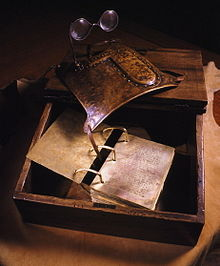
The first type of seer stone is the spectacle-like device attached to the gold plates. This was meant to help Joseph Smith visualize and interpret the words engraved upon them by ancient hands. Because these spectacles are attached to a breastplate like temple priests of old, they are later referred to as an urim and thummim.  Traditionally, the urim and thummim would help priests perform cleromancy, i.e. determining God's will in a black and white, binary way. I imagine it would provide feedback as to whether man's interpretation was correct or not. At some point Joseph Smith decides he doesn't want to work only in this rigid way; he produces his own seer stone. The one that looks like a chocolate egg.

By Welden C. Andersen and Richard E. Turley Jr.


The chocolate-colored seer stone was something Joseph Smith had from when he was a young boy and fancied himself as having the powers of ancient Hebrew seers. There's a name for this kind of behavior, it's called Anglo Israelism. In other words, those who are from Northern European descent will believe --against all evidence to the contrary-- that they are literal heirs to the same blessings of Abraham, Isaac, and Jacob. This includes claims to priesthood power, land possession, and succession. 

The amazing thing is that the chocolate seer stone seemed to work. Joseph Smith produced The Book of Mormon with it. Later, when he comes across Egyptian papyrus, Joseph Smith uses another stone (a white one) to produce The Book of Abraham. We are starting to understand now that the chocolate-colored and white stones were likely not used for historical translations, but rather inspiration to produce scripture that deepens our knowledge of God.  

I have a testimony of The Book of Abraham. By extension, I believe those seer stones worked, not because Joseph Smith has the blood of Ephraim pumping through him, but because God blessed him to use those stones for enlightenment as He did with the Brother of Jared. This ability to act as seer further established Joseph Smith's authority as head of the restored Church. 

And then he was murdered without a succession plan.

It seems unthinkable that after all that effort to restore the Church of Jesus Christ, a framework for how it should continue was not solidified. And yet there it was, a succession crisis lasting 6 months! Thankfully the doctrine of having an established presidency with keys was already in place, but who should combine those keys and take on the mantel of president, prophet, and seer was up for serious debate and produced several factions in that time. 

Ultimately Brigham Young took the reins of the Church of Jesus Christ of Latter-day Saints, but not since his predecessor do we see presidents of the Church using seer stones to establish doctrine and scripture. And yet we know the Church held on to the seer stone(s) because it was able to produce this item recently for exhibition

This is because, I believe, those stones serve as a type of "budded rod." Please allow me to explain.

The "budded rod" is described in the Old Testament as proof that Aaron and his sons should lead the Israelites. The parallel to the latter-day succession crisis is astounding. In both cases each of "The Twelve" believe they are next in line for power and authority. In Numbers 16 we learn that God commands the 12 to lay out their staffs (AKA rods) and return in the morning. The next day Aaron's staff has bloomed and has produced literal fruit (almonds). That secures his place as leader, and the rod's place in the Ark of the Covenant, next to the gold pot of manna, and the 10 Commandments. What was Brigham Young's "budded rod"? I surmise that it was the seer stone, which had produced the fruit of The Book of Mormon and was handed over to him by Oliver Cowdery

Brigham Young and his successors would likely deny it. He wanted it known that his authority lie in in his proximity to Joseph Smith AND being a literal descendant of Israel, like so many past presidents of the Church purported to be since. But a few things point against lineage being the actual, literal reason. First, we have modern hindsight to inform us that LDS presidents were mostly Northern European by DNA. Second, Brigham Young held on to the stone despite never using it --to our knowledge-- to produce scripture. Third, this could be coincidental, the box the stone was kept in was adorned with a rose blooming from its bud.

I need to take you a bit deeper into this symbolism if we're going to discuss applications for today. If we think the seer stone is a type of budded rod, then I imagine gold pot of manna is represented in our time by the new and everlasting covenants revealed to us, and the tablets are the scriptures by which we'll be judged. Just like in the days of old, the Ark of the Covenant is the outward representation of a people united and led by God. It also cements the authority of our doctrine. 

The imagery of the gold plates providing mana to our souls today is very beautiful. Let us not forget the plates were not the only things given to Joseph Smith by the angel, Moroni. He also presented the Sword of Laban and the Liahona. I think we tend to take that in as a neat factoid, and evidence that the events recorded in the Book of Mormon really did happen. While they certainly served that purpose, I have come to believe they were emblems of the Church Head and Body. Of Judgement and Mercy. Even of Joseph and Emma. If we combine these elements, it creates a figurative Mercy Seat atop of the Ark. I also interpret them as a warning: Lose your way and you will lose your life. 

Woman as the compass or Liahona is not an original thought I have. The scriptures and temple are teeming with this connection. And while I am more drawn to symbolism than early Church history, I do know that when Joseph Smith introduced polygamy Emma Smith became withdrawn, Joseph was murdered, and Emma --who had been charged to discern truth from error-- ceased to journey with Brigham Young. Since that time it seems the modern Ark of the Covenant went West, separating itself from the Mercy Seat, leaving a space filled with enmity between the men leading this Church and the outspoken women who ask them to redirect. 

Enmity might seem like a strong word, but I don't know how else to describe the response Brigham Young and his successors had after Emma stayed put. The words of the temple were changed so that women no longer received blessing unto God, but their husbands instead. The Relief Society became an auxiliary organization, instead of part of the "kingdom of priests." Further light about Heavenly Mother was stunted or blocked. And much more in the era of Correlation. This is life without a Mercy Seat, if you ask me. 

I wish to emphasize two things here. First, if you've read this far, thank you. Second, the new figurative Ark established Brigham Young as the one who should succeed Joseph Smith, and that authority lives on through our current structure utilizing the laying on of hands. I still can (and do) sustain current Church leaders in their roles because they are legitimately assigned to them. The only insight I have carved out for myself is that this legitimacy isn't rooted in Ephraimite blood, but rather a stone. This view further underscores my interpretation of Church leaders as the "wild branches" in Jacob 5 who are keeping this Gospel alive despite simultaneously bringing it to its knees (e.g. here, here). 

As Church authority lives on hand to head, remember too that Emma has a "lineage" of placing her hands on heads that are keeping up the work of discernment. And it is work. It would be much easier to simply take everything said over the pulpit as God's truth spoken by his Ephraimite messenger, and not challenge the messengers to produce tokens to validate. As Revelation puts it, straddling verses 11:19 & 12:1-2:

19 And the temple of God was opened in heaven, and there was seen in his temple the aark of his testament: and there were lightnings, and voices, and thunderings, and an earthquake, and great bhail.

aAnd there appeared a great wonder in heaven; a bwoman clothed with the sun, and the moon under her feet, and upon her head a crown of twelve stars:

And she being with achild cried, travailing in birth, and pained to be delivered.

Pained in delivering this ark, this Church and its proclamations in the latter-days. I don't know about you, but I feel that.  

Wednesday, May 20, 2020

Women and Church Callings: Under the MAGNIFYing Lens

"We've called you to the nursery!"

 I was chatting with a friend whose very devout LDS mother-in-law told her a simple truth, "Women find value in church callings."  And I've been thinking about this ever since, because in the context of the conversation this woman was implying personal value.

This friend of mine is a lawyer; I'm a doctor. We don't derive much value from organizational* callings, to be quite honest. We were on this subject to discuss just that. Is it because we're cold-hearted career women? Ha! Do we love service? Yes! Do we want to dedicate our time and talents for good? Yes! Do we think that's best done within the stifling constraints of the patriarchy with the expectation that we'll use much of said time and talents to be a craft queen and the hostess with the mostess?** NO. So as we were discussing this she shared that quote from her mother-in-law, a stay-at-home mom. It came from the heart and with an explanation that so many LDS women forego education and/or career to raise a family without recognition. Church callings, this mother explained, give women like her a job to do with certain deliverables (my term, not hers) that garner public praise. In my experience these deliverables are often a seasonal banquette with impressive centerpieces and checked boxes for young women's activities. 

I love that this woman and so many other LDS women can find fulfillment like that. What I'm not keen on is the setup that makes these callings essential nourishment in a system that is anemic with female power. To be specific, several generations have passed during which LDS women have been exhorted/told/commanded to sacrifice their aspirations to support their husband's career, and instead accept callings that groom them to consistently double-check with a man. When a "good LDS woman has to work" (she'd never choose to, right?) too often she's made to feel contrite about it, and this is where church callings are accepted as penance. It's not a good look. And there are those who might interject at this point to say a woman always has the ability to decline a calling but, let's be clear, there's a lot of guilt built into that. The better thing to examine is if a woman can ever really give full consent to a calling when told the "offer" is coming from God and confirmed by a man whose power will always trump her own. 

This is not just a thought exercise for me and my friend. We're both at the age where childbirth is wrapping up, kids are nearly all school aged. For us this means we're more likely to be called to an organizational role (which was indeed the case for me).  For our same-age friends who find their value in church callings --let me be clear, this is not synonymous with staying at home-- I'm observing, hearing, listening to them explain a seismic shift to their world and their response to that, which appears to be either a doubling-down on church calling commitment and/or an honest reexamination of their life's choices to determine if they'd been true to themselves. A dear friend of mine determined sacrificing her aspirations had been the result of institutionalized shame, and this realization happened to occur when she was released from a calling. She described it as falling without a rope to hold on to. My heart broke for her. 

No woman should be led to feel or believe her worth rests in church callings. If you're reading that thinking no one is doing that intentionally, that's fine, but it's happening anyway and we need to stop that. At the same time, I do believe in helping where I can and accepting inspired callings that humble me because Lord knows I need it, and I know my worth isn't defined by my outward performance. And I share that as an educated woman who not long ago was chided for putting the "iron rod cheese stick in the Nephi fruit boat" as part of her calling. The struggle goes on. 


*i.e. "leader" versus teacher
**seems to be the cultural expectation

Friday, April 5, 2019

See One, Do One, Teach One

Seems legit.


In the medical education system you start out as a medical student with no real power to execute orders, to a resident physician with the ability to make decisions, order tests, and prescribe medications ... so long as your full-fledged attending physician signs off on them. Finally, after board certification and completion of residency you're the real deal. You fly solo, all power and liability is on you.

In medicine we also have a "See one, do one, teach one" motto. When you're a medical student your job is to mostly observe what the doctors do. You might interview patients and write notes, but those things don't really count in the medical record. When you're a resident you have a bit of a safety net under you and this is when you start doing real things under supervision. By the time you're an attending physician the idea, in an academic setting, is to mostly teach the residents and medical students.

So why am I giving you the inside scoop on how the medical field works? It's because I suspect President Nelson, a physician surgeon, applied these academic principles to Church policy creation and that's how we got The Policy (re: gays and their children) and its reversal. Here's why:

In 2015 President Thomas S. Monson had severe dementia. The Church was being run (as is its policy in such cases) by the combination of presidency keys. We see Boyd K. Packer die in July 2015 and The Policy go into effect November 2015. What happened in the interim? Russel M. Nelson became Quorum (of the Apostles) President (QP). For context, everyone at this time knows Nelson is next in line to become prophet and Dallin H Oaks is positioned to become the next QP or higher (as would become the case).

If we view this in terms of:
apostle = med student
QP = resident
Prophet = attending physician

It would be no surprise then if Russell M. Nelson as QP jumped at the opportunity to use executive power for something that he could say was the will of the Lord, but policy only (i.e. not offical doctrine). This would be practice for the big role for which he was slated. And we know he moves quickly, wasting no time. The Policy would be his "do one."


When the Chief strikes down your order.


But what one man wants and what the Lord wants are often not the same thing.

What was supposed to happen is President Eyring and President Uchtdorf with new QP Nelson, along with the sustaining and authoritative power of the remaining apostles, were to turn their keys in confirmation of what was taught to them by the Spirit.

What I think happened is a couple of things. I think Eyring and Uchtdorf, having worked for some time now without a functional President of the Church, slipped into the mode of "I sustain our [future] prophet." They wanted him to get practice as QP and succeed. Also, let's be honest, they knew they were a geriatric heartbeat away from answering to President Nelson for the remainder of their ministry. I'm guessing that factored in.

suspect something went wrong right away. For starters, why focus on "the gay issue"? Especially right out of the gates? It seems like Nelson saw an obvious problem between homosexuality and Mormon Latter-day doctrine and wanted to fix it. I don't doubt he sought the will of the Lord, but it appears he landed on the side of legalism. And just who persuaded him to choose justice? Who likely pleaded for mercy instead (but ultimately relented)? I'll let you decide.*


*Worth a thousand words


In the end there needed to be apostolic consensus, but my guess is at least one presidency member drew near to The Policy with his lips for the sake of unity, but his heart (and key) were turned away from it. In contrast, I can see Nelson receiving guidance from someone who was close enough and practically there in terms of having presidential keys such that his input was valued more than it was worth. We see this happen from time to time in medicine, too. Senior resident and 4th year medical student start a surgical case without the attending surgeon and the patient bleeds out.

The patient in this case is everyone affected by The Policy. We can never say for sure how many LGBTQ members died by suicide as a result, but my gut and reasoning tells me the blood of this generation cries out.

The Silver Lining to a Large Black Cloud

I think three big things have/will come out of this: 1) We have learned how to discern right from wrong, 2) We now know which members will accept/reject false doctrine, and 3) More women will be brought into policy-making decisions at higher levels in more official ways.

1) I've said it before and I'll say it again, we must look for the tokens and signs Father promised to send us. When the leaders of the Church teach us a principle we should pray on it, consider it, and feel within us a confirmation that it's true. Then, when we act upon it, we should see good fruit. There was never any good fruit from The Policy. Only bad, heartbreaking, rotten products. Moreover, when it comes to church-wide policy, ALL presidential keys need to turn in agreement. This is tricky because The Policy was touted as coming from a unanimous voice, but I recall discussions at its onset about how this just didn't seem like something a certain key-holding apostle would support, at least not in his heart.

So let's say we were early saints and Peter, James, and Thaddeus approached us with new policy... Stop right there. That's not right. Perhaps the next time it came from the original First Presidency (Peter, James, and John), but they had no tokens and (good) signs to give... Thanks, but no thanks.

We need both: The actual presidency and the correct tokens and signs.


2) I remember after The Policy each and every woman I knew had a hard time with it. Even the most "totally believing Mormon" (TBM) types felt sick in the stomach thinking about babies being turned away. But within the same day of its announcement, these women and their male counterparts posted and preached about how, "if you look at it this way," The Policy is actually about love!

These members were wrong. They are dangerous. They need to learn from this and change.

3) I've looked back at my journal of impressions and the letter I gave my bishopric pleading for an end of at least one aspect of The Policy. My feeling is that this episode has made it clear that women need to be involved in policies that affect the family of God. And since that touches everything, I do expect an announcement this weekend during General Conference.


Closing Thoughts

Going back to that image I've painted of the confident resident and eager med student, I know and I hope you know they had no intent to harm. We also know the outcome was catastrophic. As "ancillary staff" did you take orders and facilitate a wrongful practice or did you run things up the chain to a higher authority?

Next time --because humanity assures us there will be a next time-- let's not accept a broken protocol nor leave the operating room; let's do all that we can. Together. Because now, as President of the Church, Russel M. Nelson is teaching us that we can learn from our mistakes and become better. Much better.

Sunday, July 22, 2018

Cover and Hide?

By now you may have heard about the woman in Utah who is being disciplined for refusing to stop breastfeeding uncovered in her church chapel.

Disapproval of the breastfeeding mother in this case stems from the same reasons given to condemn women in general for their natural, God-given bodily functions. The expectation, mostly from men, is that the breast and vagina must work in secret, behind the scenes, and under volitional control. In effect, when these body parts are not being used for their sexual pleasure, these men do not want to be bothered by them.

Most of us know about the absurd statement by a lawmaker that, when it comes to getting pregnant by rape, women’s bodies “have ways ... to shut the whole thing down.” Similarly, there was a recent case in which a woman was fired from her job because her uterine fibroids produced excessive vaginal bleeding as to cause leaks at work. Her (male) employer, and many others, could not understand why she didn’t wait to go to the bathroom to bleed.


Part of this problem, of course, is a lack education for men. The main cause of that is the expectation for women to “do their business” away from the public consciousness, especially since the biological aspects of womanhood have long been considered unclean (i.e. disgusting). I recall watching a woman give a grand rounds presentation and stop mid-sentence, grimace, and then explain that she was experiencing a menstrual cramp. While that might fall in the “TMI” category for some people, she felt it was important to explain what was occurring instead of giving the impression that she was under-prepared to speak on her subject matter. For many in attendance it was the first time they realized that in the background of life women are juggling the demands of their glands.

Now we have plenty of people, especially men, saying that this breastfeeding mom should have held in her milk and waited to go elsewhere to do her business out of sight. They don’t know what it’s like to get a sudden letdown of milk that is actually NOT under their control, and only intensifies as the child cries to be fed.

To them it may seem a short distance to the mothers’ room (AKA breastfeeding hut), but the time to get there has caused many a mishap. —Which I know from personal experience. (FYI, getting one’s dress covered in milk, and/or publicly squirting one’s fluids through their clothes is not fun.)

It’s also not fun to suffer from social isolation at church. —Especially when your week is already marked by it. Sitting alone in the mother’s room can feel terribly lonely, and even unsafe. To be forced to do so adds a level of shame.

I’ll never forget the day I decided I was never feeding in there again. I had rushed to sit down and feed my child (as one does) and realized the switch to the speaker was beyond my reach after the baby had already latched. It was then that the pungent smell of a dirty diaper wafted over to me. There I was feeling stuck, seemingly punished and excluded from sacrament meeting all because I was performing the so-called “highest and holiest calling” as a mom.

When the mothers’ room is well-attended there are other factors to consider. This space is often used to calm down children who are tired and overstimulated by 3(!) hours of church. If you thought moms could still tune in to the sacrament talks you’re mistaken for this reason.

By now I’m sure you’ve read and been told why covers don’t always work (and can in fact bring MORE attention and exposure to the breast). You may have also been told why some women need to expose more of their breast as this depends on baby's ability to latch, mom’s tissue density and propensity for blocked ducts.


Source
Satan's plan would have us run and hide our bodies in shame.
God's plan endows us with power and agency.


But ultimately those details should not be our focus. We should be more concerned about the unrighteous dominion of this woman’s priesthood-appointed leaders. We should be bothered by the fact that breastfeeding has become so sexualized. When my husband went on his mission to France during one of his first Sundays there a woman got up to bear her testimony, her baby cried, she exposed her breast to feed the infant, and continued on as normal. Was that shocking to him? Sure! But guess what, he got over it. If anything, those concerned about triggering porn-addicts have got it all wrong (as usual), because seeing women as more than their parts is helpful to establish healthy relationships.

So to me, what this issue boils down to is men feeling uncomfortable with having to acknowledge women’s power. The power to perform so many tasks at once, to give and nourish life, and dare to do so without shame, without hiding. Once you see the power struggle for what it is, you will not be surprised that a man wants to exert his authority to prevent her from claiming more power (in the temple). You will understand why some men will side with her bishop and stake president, while those confident in their manhood and armed with appreciation will stand with her.

Monday, January 22, 2018

High on the Pedestal


Source


A few weeks ago I was pounced on by feminist friends who didn't appreciate my observations about the temple. Specifically, I said the temple was based on the premise that women came to earth with "unique endowments that are not common to man." I was told that I was pedestalizing women, putting down men, and that God is not a jerk like that.

But, what if He is?

I mean, if your definition of a "jerk" is treating men and women differently, then I gotta say you're setting God up for a rough review. This is, after all, the eternal power who authored menstruation for women and wet-dreams for men, y'know?

His ways really aren't our ways. Always.

At this point in my ponderings, I think God endowed women with His greatest power, but we are in the chapter of The Plan where outward things are focused on the male-driven offices of the lesser Aaronic and Melchezidek priesthoods. I have hope that further light and knowledge will come so that the awesomeness of women can someday be realized and acted out in the open.


I realize that's terribly unsatisfying for the present time. This is why, when I share my insights, I typically get one or all of these reactions:
  1. "You're making stuff up."
  2. "I reject the temple as it is the product of sexist men."
  3. "If men don't acknowledge our power, what's the point?"

Regarding the first reaction, I can tell you I'm not lying. Go to the temple, hear that the temple endowment for women is our further endowment, and note how Eve is portrayed as a wise, mature, and upright woman alongside the newbie Adam. (If you try to Google this you won't find it.)

As for the second, I will say that a word change here and there would go a looooong way to improve woman's temple experience. Just as important, I think such changes could be in line with how God really sees us. That being said, I'd like to pose a question in response: Without the temple what do we have? The eggs of equality, if you will, would then rest in the singular basket of us being ordained to the Aaron and Melchizedek priesthoods and I can't help but feel that is beneath us. To me it would feel like we were selling ourselves early for a lower price than what we're worth, precluding the possibility that something much greater lies in store. Which leads me to the third item...

The final point is where we come together. I don't like the imbalance of power either! I really resent that we as women have so much to offer and it's constantly overlooked. I feel sick when men who note what I have observed use this insight to speak to women in a patronizing way. I.e. "Ladies, let us run the whole show, because otherwise you'd be too great a force to reckon with. *wink*"

From where I stand, I think there's only two ways out of this rut. We need to pray (literally pray) the president of our church seeks and receives the messages Father promised to send us, and in the meantime stop resting our worth on acknowledgement from men. I see this playing out as we attend church for the ordinances (not the people), call out sexism wherever we see it, and start discussing women in the scriptures and in the modern church. I noticed the Young Women's presidency is starting their research into this and that gives me a lot of hope. 

What I'm suggesting requires a ton of patience and long-suffering. The current Church setup is not just, nor is it merciful to women who find themselves out of place. When I die, and if I'm fortunate to meet God face to face, the second thing I will ask them about is why we had this power dichotomy. (The first question, of course, is going to be about menstruation. WHY?!) 

Tuesday, January 2, 2018

The Priesthood and The Vaginas

I've been taking online courses to be able to code in a computer language called Python. Once a week I am graded on completing an assignment that requires me to write a program that works based on conditions and values that I get to set. It's pretty neat. Lately, I've been applying these concepts to real life situations. Like, IF laundry ignored x 1 week THEN output equals much sorrow in the home. --I can confirm to you that that is a true statement.

With regards to the Church, I've looked over our coded language and I think I've discovered a program that goes like this:

The Priesthood = Men/boys

The Vagina = Women/girls

WHERE Vagina = All sexual female organs (as lawmakers are want to define it)

IF The Priesthood = All that is good and most important
THEN All that is good and important = Men/boys

The Vagina = Makes Men/boys = Vital object 


When I started testing this out, I noticed several patterns. The most common was using Women/girls as object lessons as though they were, well, NOT equal to most important.

Take Elder Nelson's talk, A Plea to My Sisters. I recommend watching it on video. He describes the trial he faced when he was a less experienced surgeon. Two little girls died after he performed heart surgery on them and he was devastated by this. At this point in the story, I thought he would speak about forgiving himself for failing. I was hoping, honestly, that he would speak about those little girls a bit more and talk about the Atonement offering a hope of reunion between them and their grieving parents. Instead, he finishes on a climactic note explaining that with his first wife's urging and having learned from his poor outcomes he was able to operate successfully on President Kimball. And since Pres. Kimball = good and most important, this is supposed to sweep those little girls under the rug of our memory and convert this into a happy, uplifting story. (Listen for the audience gasp of relief.) Those girls, after all, were learning tools for The Priesthood.

The habit of using females as object lessons, once you recognize it, you'll begin to see it everywhere. Take this talk given by Sis. Cordon, Trust in the Lord and Lean Not. Normally we wouldn't think to make a negative example out of someone battling cancer, even lightly, even with their consent. But hey, an object is not a someone thus Sis. Cordon explains how this one poor lady had sunk so low as to feel sorry for herself while she was receiving chemotherapy (imagine that!), but The Priesthood (her husband) wisely put such negativity aside and made sure she could still find a way to be of service. There's even this one super uncomfortable moment in the video where the speaker is relaying the trials of chemo and the audience laughs (7:08). Laughs! To be clear, I'm not saying Sis. Cordon is purposefully trying to come down on this woman, but I am saying that we have a habit of using women to teach lessons through stories that are sad, but not too sad as they're buffered by equating women to something less important, even humorous. Silly vaginas who need The Priesthood to point out their silly ways. Conversely, if you really want to make 'em sweat, talk about The Priesthood nearly falling to its death, facing hypothermia, or anything like that.

We are so used to equating females with objects, as less than human, that we're okay talking about them dying, replacing them, and being upbeat about it. Elder Oaks has done this, and recently Elder Kevin R. Duncan thought that'd be a great Merry Christmas message for the masses.

To me, no better example of this setup exists than in a phenomenon occurring throughout the Church relating to woman's use of the church building. As a matter of policy, a woman should not to be left alone in the church. Many have taken this to mean that The Priesthood should be supervising women whenever they use the facility, even when there are many, many women on the premises (i.e. they're not alone). To try and argue this is to often meet a bishop who simply cannot compute: vagina does not equal person, after all.

Now we can laugh or cry about this all we want. The first step to fixing it is recognizing the pattern and calling it out. In doing so, I hope you won't end up as the object lesson in a cautionary tale of how vaginas women ought not behave.

Addendum:
I wish to point out that in the earlier referenced talk by Elder Nelson, he does go on to say that women are important and their strength is needed. But all of this has been framed by an object lesson that shows how feminine gifts are there to bless the lives of The Priesthood. Instead of being told how "vital" they are to the Church, to The Priesthood, I think an improved experience could be had if we taught women how to find strength within themselves for themselves, to be used as God sees fit. I realize that sounds like I'm splitting hairs, but it's like the difference between telling a woman she is complete and has a direct connection to God, versus saying she can access Him through her husband as a complimentary tool.

All I ask is that we stop using women as object lessons and see them as full persons. Consider that a belated Christmas gift wish. 

Sunday, December 3, 2017

Polygamy is NOT an Eternal Principle

A few months ago in Relief Society, a sister in my ward casually mentioned that polygamy is an eternal principle. There was no push-back on that, it was just accepted and people moved on.

Except me, of course. I let it simmer in my mind for much longer than I should have.

I eventually reached out to say that while I appreciate the perspective, this conclusion is not official doctrine* and I for one do not believe it, so please be mindful there are differing views in the room. We had a pleasant conversation from there, but the usual tropes came out...


  • I was encouraged to read the scriptures and pray on the eternal nature of polygamy.
  • I ought to think of the sister who never married. --I wouldn't want to let my jealousy stand in the way of her exaltation, right?


All of this assumes God didn't have the foresight or math skills to get the ratio of righteous men and women right in heaven. It also ignores the fact that many more male infants die in their angelic state than females.

So what do I say in response? First, my typical snarky comeback:

"Okay, well, if you're all cool with polygamy, I'll be sure to volunteer you to share your husband with the billions of women who need him to get into Heaven." Thanks for taking a hit for the team!

(I'm a jerk.)

But in all seriousness, my next favorite line to deliver in this case is:


"Don't stop me now, I'm having such a good time. I'm having a ball!"


We should look forward to polygamy in the Celestial Kingdom as much as we would gleefully anticipate sacrificing our sons on altars there, too.


Which is not at all.

Indeed, when referencing polygamy in Doctrine and Covenants  132:50 we read:

Behold, I have seen your sacrifices and will forgive all your sins; I have seen your sacrifices in obedience to that which I have told you. Go, therefore, and I make a way for your escape, as I accepted the offering of Abraham of his son Isaac. (Emphasis added.)

Polygamy hardly seems like a celestial reward when it's likened onto a great trial. Note too that God intends to remove this hardship at some point, though the timing of that is unclear. Many even believe Joseph Smith was able to escape consummating polygamy because for as many wives as he had, we only know of children coming from Emma (modern DNA studies continue to support this).

How then can people say polygamy is eternal? I used to approach this topic from the point of defending my conclusion, but today I've had enough of that. Today I play the offense and ask others how they can still promote an ideology that is not only blatantly false, but just as important hurts so many women!

I could concede a fair counter-argument in favor of polygamy...

If The Creation story featured Adam and Eve and Janet and Cindy. That is to say, if the Male:Female union weren't the standard and ideal from the beginning.  
If LDS polygamy produced more children than would have otherwise been expected of traditional marriage (news flash: It didn't).  
If men routinely outlived women (the opposite is true), allowing them more opportunities to remarry.
And especially if The Book of Mormon didn't deliver a scathing condemnation of polygamy except to allow the case where God tries his people with it (see Jacob Chapter 2, also Genesis 38:9-10). 


Bonded, but not sealed by Krazy Glue


At this point, some might point out that sealings have been performed for multiple women to one man and that this practice still goes on today. That is true, that's not wrong, but it's not entirely correct to understand it that way. One must first realize that the word "sealing" as it is used to describe temple marriage is a misnomer. A "sealing" is not actually a sealing (i.e. enduring) until it is bound by the Holy Spirit of Promise, this is generally understood to take place with a Second Anointing ordinance that includes the Washing of the Feet. When the sealing power was restored to earth and in both Kirtland and Nauvoo, men were married and "sealed" to multiple spouses, but second anointings were reserved (in almost all cases) to the first wife only. This would support the 1:1 male-female union as eternal in nature and anything else as temporary.

Furthermore, Jesus our Exemplar repeatedly showed us that female singularity is key along the path to exaltation. Though obvious, Jesus was born of ONE woman, from a virginal womb. In death, he was laid to rest in a virginal tomb (never used before) and returned into the presence of ONE woman, Mary Magdalene. Similarly, though Abraham had other wives and far-outlived Sarah, when he died he was interred next to his first wife's grave and hers alone (Genesis 25:10). This pattern would be repeated with Emma Hale Smith laid next to Joseph Smith Jr.. These examples give a picture of what the morning of The First Resurrection will look like, and it's not a polygamous model.

Do I point these things out to dig at subsequent wives and single ladies? Do I not care about their eternal destiny? Am I motivated out of jealously to share this viewpoint?

I've taken away nothing. The concluding argument pro-polygamists have always given is not to worry, "everything will work out in the end." That last bit remains true. We both agree that God is love, He is merciful and will take care of everyone in His great plan. The fundamental point where we differ is, I have faith that His plan does not handle women as expendable, dime-a-dozen figures in a play centered on man. Rather, I propose this radical thought that we are of equal worth, and that the singular male-female union is celestial. Worlds without end.


Addendum: I was asked when, if ever, God gives the "green light" to the practice of polygamy. To that I say at most He will give a yellow light, which is to proceed with caution in the following circumstances based on scriptural references:

  1. The Law of Sarah is invoked in a permissible season. That is, when a woman requests that her husband take an additional wife and the Prophet approves it. 
  2. As in OT times, when a man dies and his brother is legally required to marry his widow for protection and provisions. Today there are men who feel prompted to marry a widow who had been sealed to her first husband in order to "raise up seed" to him.
  3. When God decides to try his people? Ugh. But even then I have faith He will provide an escape as mentioned earlier. 

In 2/3 cases, the focus appears to be doing what the woman wants, which I found to be fascinating. And note that the third item can be satisfied by the second scenario described, potentially making this 3/3 pro-woman. 

Also interesting, the Second Chapter of Jacob says polygamy is not to be practiced unless God commands it for "raising up seed." A search of the scriptures reveals that the phrase "raising up seed" by itself is typically used in only two ways: In the general (i.e. not related to polygamy) sense of righteous branches of The Tribes needing to keep their line going, and the more applicable Old Testament setup of brother-in-law duty to widows mentioned above. (We're thankfully past that now.)

As for the prophecy that one day 7 women will grab a hold of 1 man and ask to be called by his name (see Isaiah 4:1), I think it's possible that as the elders flake out on us there will be many righteous single women in the last days who will yearn to have their temple ordinances complete and request good men to stand as proxies for their would-be-husbands. I'm not fretting about this for two reasons: 1) Again, a sealing is not a sealing until it is bound (i.e. things will get sorted out later) and 2) I've already volunteered my RS sister's husband to take care of all that. :)


*Ironically, Bruce R. McConkie in his book Mormon Doctrine (which is not actually Church sanctioned) says that polygamy is forever... But he also said blacks would never get the priesthood, so miss with me that

Saturday, October 28, 2017

A Modern Parable

While the temple ordinances have changed, the hurt felt by many women lingers and I'm leaving this here as a testament to that reality. I can do this and be grateful for the improvements at the same time.

Sunday, October 1, 2017

The Proclamation: A Bait and Switch for This Convert

When I joined the church, the reasons new converts gave for their conversion sounded like this most of the time:

  • I know the Book of Mormon is true
  • I have a testimony of The Restoration
  • Joseph Smith was a Prophet
  • This Church has priesthood authority

When Prop 22 rolled out in California, there was a renewed focus on The Proclamation, and I started to hear these reasons more and more:

  • I love my family
  • I love my boyfriend/husband
  • I love tradition

Though not given as THE reason for adopting Mormonism, I have heard from convert men that the Church's strong stance against homosexuality through The Proclamation was definitely a draw for them. (Oddly enough, such commentary also paves the way for racist opining... Are these the recruits we want to shoulder the priesthood moving forward?) 

And while I don't have sound data on this, my personal observation has been this irony: With the Proclamation focusing on the heterosexuality of a marital union rather than the priesthood power to perform sealings, I have seen more marriages occur outside the temple (with sealings to follow in a year) than before its emphasis.*


Actual results for #lds


When I joined the Church, Instagram wasn't a thing (man, I'm getting old) but when we conjured up imagery of being a good Mormon it mostly centered on preaching the Gospel and helping others across the globe. Now when we seek #lds, #mormon we are bombarded with pictures of women looking "modest is hottest" in gender-traditional clothes and cute couple selfies. That's all correlation not causation, of course... But seeing as the Book of Mormon (written for our time) says next to nothing about marriage, homosexuality, and looking #totescute you might begin to understand why I find this abrupt shift in priorities so alarming and make an association. 


WHERE IS THE CHURCH I JOINED?!

In Sunday school I would rather discuss the implications of, say, the Oath and Covenant of the Priesthood or overcoming poverty, but instead we're talking about how it's Us against the World, and by marrying a man I really "defended the family." Defended how, from what, from whom?

With Utah as our canary in the Mormon coal mine, shouldn't its high(est) rates of sexual violence and child sexual abuse, pornography use, and its push for perfection through plastic surgery alongside sky-rocketing mental illness all be signs of where we should focus our talks on family values? My wearing lady-like skirts with lipstick and passively not being gay in accordance with The Proclamation doesn't add anything to over-coming these challenges. And while you might point out that document does contain condemnation of abuse, that has hardly been the focus of our discussions on it.

Moreover, if the point of belaboring The Proclamation is to remind homosexuals they do not fall into Gospel ideals, I would like to speak on their behalf and say they're already well-aware. Like, so much so we lose precious human beings to suicide routinely in our church.

INSPIRED?

In Elder Oak's talk yesterday he mentioned that it was important for us to know about the origins of The Proclamation. He happened to confirm what Chieko Okazaki had said, that this document about families was created without any insight from women. He then used indirect wording to describe The Proclamation's origins: "Language was proposed, reviewed, and revised," and "a proposed text was presented to the First Presidency," which is a missed opportunity to snuff out reports that The Proclamation was conceived in partnership with the law firm Kirton McConkie in anticipation of legal challenges to same-sex marriage. --A fight that was solidly lost here in the USA. 

Finally, Elder Oaks posits that embrace of The Proclamation is a measuring stick for converted Latter-day Saints. Given that this document is not canonized, never received by common consent, I was taken aback by this suggestion. It's true, I don't display this document in my home... But I keep the covenants I made when I joined the Church, which includes mourning with those who mourn the Gospel they once knew and recognized.

*Not that I personally have a problem with that, but I know the Church cares a lot about temple marriages

Tuesday, July 28, 2015

Of Time, Office, and Power

UPDATE 2 (2021): The temple wording has changed, but the framework of the Church hasn't. I'm going to file this under the "still potentially helpful" category. 

UPDATE 1 (2018): I wrote this post some time ago. I still agree with the conceptual framework and I know that it is in harmony with temple wording, and that we are awaiting further light and knowledge. As Elder Neal A. Maxwell put it, "The story of the women of God, therefore, is, for now, an untold drama within a drama." I build upon that today to say there is more women can do than simply wait and see if we will ever have equality. We can tap into our powers of seership, healing, and summoning now.  Yes, there is more to the story than what is presented at church on Sunday, and 165 hours remaining in the week to claim it.


Y-axis = Office; X-axis = Time (pre-mortal to mortal to eternal)

PLEASE NOTE THAT THIS IS 
NOT SUGGESTING MOTHERHOOD = PRIESTHOOD


Last year I sat in on a speech therapy session with a patient who suffered a stroke, I didn't think this experience would make me ponder the role of men and women in the Church, but it did. As the therapist began to explore and suggest strategies for the patient to relearn how to do fundamental things for himself, his wife kept interrupting to say she could do those things for him. She had missed the point of her husband’s acute rehabilitation stay. The speech therapist had to explain that this was a time for him to learn how to do things for himself, even when the results were considered inferior to what she could provide. It was the only way for him to make progress. “It’s like he’s starting out as a little child, and I have to support him, don’t I?” Her response confirmed her understanding, and seemed in line with how Latter-day Saint women are asked to sustain the brethren as they grow within offices of the priesthood.

Above I’ve charted a visual representation of “office versus time” to describe how I see things playing out for both genders. It shows woman’s condescension to this mortal realm in which things are governed by lower offices, namely the Aaronic and Melchezidek priesthoods. At this stage in the Plan, Woman agrees to accept conditions as they are, as they benefit Man’s spiritual growth. She may carry out callings with authority granted within those offices, but is not permitted to perform ordinances outside the temple using power not allocated to her. – That is not to say that she is incapable of performing ordinances (she does, after all, have that "other priest(ess)hood"), but much like a person who has the skills to drive, they are first required by governing laws to have a permit. They also need keys. And I believe these permissions are not given to women directly because mortality has rolled forth in the direction of the Father (not the Mother). Or in other words, this is Man's acute rehabilitation program, not so much Woman's. She has already proven herself true and faithful to the principles of the Gospel (reference: initiatory).

I never intended to test it out, but I can share a personal experience in which I used my “other priesthood” power to confirm that it is real. It was 2012 and I had come home from delivering my daughter. I was suffering from terrible cramping and my newborn was struggling with nasal congestion. Hearing her gasp for air was upsetting my condition even more and my husband appeared torn as to who he should care for in that moment. I could bear it no longer and I instinctively raised my arm to the square, called down a healing blessing upon me and my family, and a current of energy came through the house. The baby went straight to sleep, by belly stopped aching, and peace was restored. My husband was just as shocked as I was. 

I’ve gone back to the temple to ponder that moment and the stories of other women with similar experiences. I’ve been amazed by how many others have essentially picked up the keys* and hopped behind the priesthood wheel when they felt the situation (usually urgent) called for it. Why was this otherwise limited to the temple? Why couldn’t I share priesthood duties with my husband out in the open? As I reflected on Eve cleaving onto Adam -- who is progressing in the direction of Heavenly Father-- I see that this is a temporal setup. This is not the big picture. This is our temporary and literal sub-mission, as we assist our husbands in becoming clean and wise.


X-axis (time) removed. 

What do we as women get out of this? A physical body. A companion who is loving and whole and ours for eternity. We gain families and a knowledge of the Savior who helps us to progress. On a broader scale, women throughout time come to earth with their unique endowments, whereas relatively few men on earth ever obtain divine power. I have to believe that at some point we thought this was a good deal. And I have faith that it is, but it does help to see a way out of the mortal setup. A light at the end of the tunnel, if you will. For that reason, I have figuratively merged each office as they stack on top of each other like an escape ladder (see above). Since Woman left her high estate to join Man on the ground level, she too must obtain the signs and tokens from the mortal endowment (his first; her further) in order to climb  through the levels of the Aaronic and Melchezidek priesthoods. I strongly believe that after the sentinels are satisfied, we will rise up together using the key(s) designated to woman (and revealed to man)  and that, finally, we can unveil our glory. This may happen either in this lifetime (2nd anointing) or the next (exaltation). But it will happen.


At this point, many would say that I’m suggesting women are merely accessories to their husbands and have little to add to this earthly existence. No. In all things men are to counsel with women who actually hold the highest calling to be assumed by mankind: motherhood. And why is it called the highest? It's more than a platitude. Motherhood is a by-product of a higher priest(ess)hood office in which daughters gained skills and power from Heavenly Mother pre-mortally. By extension it must needs be above the Melchezidek and Aaronic offices. This divine nature is meant to bless mankind and goes beyond human reproduction. Thus the Church suffers as a whole when “the priesthood” overlooks women’s contributions and/or doesn’t request their insight when going about its business. It is not good for man to be and —if I might add— act alone when so much strength and power is literally at his side. God is best served and the Adversary rebuked when man and woman work together as a team. That this ideal is not always upheld by imperfect people does not change those underlying principles.

(Others might say this analogy paints men as immature compared to women, at least at the start. I have no comeback for this, especially when I reflect on how Adam is portrayed in the temple.) 

I pray this perspective offers hope, but I don't expect others to see eye-to-eye with me and that's okay. I personally find hope in it, but acknowledge that real life applications sometimes miss the mark. There are plenty of men, for example, who presume that because they “hold the priesthood” they are superior to women (oh, irony). Many misconstrue the charge to preside in the home to imply ownership when, to me, that mostly means they are accountable for each family member receiving all the ordinances pertaining to the Aaronic and Melchezidek priesthoods. I also concede that current constraints on women’s authority likely go beyond what God had intended. 


Extensions of priestesshood, now gone 

Above is an image showing extensions of priestesshood that have been performed here on earth previously, but were done away with during the Era of Correlation. In my estimation, acts such as mothers' blessings of daughters prior to birthing do not take away from man’s apprenticeship in the Aaronic and Melchezidek offices, but instead elevate the family. Even so, this opinion of mine and aforementioned short-comings do not stir within me a desire to shatter the framework I’ve described here. I’m inclined to work within it and pray the missing pieces will come together again. For I have faith that, while certain aspects may be lacking, the broader design or rungs on the ladder will nevertheless lift both man and woman. 

This brings me back to my stroke patient. After we spoke with his wife she was committed to letting her husband practice and progress. Our neuropsychologist added that as the husband's decision-making capacity improved, it would bolster his spirit and their marriage if she were to hearken refer to him when appropriate. We also emphasized that she should remain with her husband to prevent him from ever falling. This woman was his key to safety.  As they prepared for their eventual discharge from the hospital, I couldn’t help but think their situation is a lot like what Adam and Eve covenanted to do. They were facing hardship together, each with his/her portion to contribute, but united in a goal to ease each other's burdens and return home. It seemed unthinkable then, that should this patient gain enough strength in his arm that he would raise it to do anything but serve his wife with gratitude. Such is the case with power in the Aaronic and Melchezidek priesthood(s), with its promised homecoming even sweeter. 

*I presume this is possible either because 1) being from a higher office grants a general "master" key or 2) the sealing between husbands and wife allow her access onto his power. After talking it over with friends, I'm inclined towards the former since young unmarried women do not need ordination to the Aaronic priesthood prior to entering the temple. 

Sunday, April 26, 2015

What is the Role of Women on Earth?

That's a big question, isn't it? To some, it may even sound insulting. I bring it up because, in the Church, the role of men is well defined, so clear, and very expansive. When we talk of women, however, we get focused on marriage, family life, and nurturing and seem to run out of other things to say.

Earlier, I wrote about viewing the temple endowment as a further endowment for women (not men), which points to gifts specifically given to them prior to coming to earth. What exactly do we do with that? How is that pre-mortal gift to play out in our lives now? What purpose does it serve in our individual lives and as members of the Church?

Here I will outline what I believe are the unique contributions women can make within the (current*) framework on the Church.

PROPHETESS

The Bible dictionary defines the word 'prophet' as he who holds all the keys and is president of the Church or, generally speaking, anyone who has the spirit of revelation.

Additionally, The Guide to the Scriptures specifically defines 'prophetess' as follows:

PROPHETESS 
See also Prophecy, Prophesy 
A woman who has received a testimony of Jesus and enjoys the spirit of revelation. A prophetess does not hold the priesthood* or its keys. Though only a few women in the scriptures are called prophetesses, many prophesied, such as Rebekah, Hannah, Elisabeth, and Mary. (Asterisk added)
[*In my own reading of this, I take "priesthood" to mean Aaronic/Melchizedek, not the broader term or "capital 'P' Priesthood" described here.]  

From this I feel that there are 4 distinct categories:
1) The Prophet (Thomas S. Monson as of 2015)
2) prophets (anyone with a testimony and the fruits thereof)
3) Prophetesses (named as such in the Bible, e.g. Miriam)
4) prophetesses (see below)

To me, prophetess suggests more than female "little p prophet." I base this on the Creation story in which Adam is clearly described as being made from the earth and starting life as a little child, forgetting everything that had occurred pre-mortally. In contrast, Eve is brought to him as a sage counselor who can see much more than what the eyes view in front of them (see also). For revelation, as I deem it, is not just seeing into the future, it's also remembering the past. --Even the pre-mortal existence with insight that can affect mortality. In this, Eve and her daughters are well-equipped. That uniqueness, in my opinion, is what warrants that fourth category for prophetesses.

We see examples of prophetesses (as described above) throughout the Bible and worth noting is that their power is usually on display in matters affecting their descendants. Rebekah for example prophesied that it was Jacob, not Esau, who should receive the birthright, and she took the situation into her own hands (even deceiving Isaac) to make things so. Similarly, Elisabeth prophesied that her son would be named John, and she came to this conclusion independent of her husband. Keeping this pattern, Hannah knew to dedicate her son, and only child (at the time), to the Lord in His temple as he would later become a prophet. In all three cases, when future generations hinge on foretold knowledge, it is woman's distinguished place to set things right. This makes her a prophet(ess) in the most distinct way.

Outside of the scriptures and in everyday life, women act as prophetesses when the veil is made thin to them as a privilege owing to their true and honest hearts. They are to share that insight with their families and one would hope that it is accepted and acknowledged.

ANGEL MINISTER
Angel mother is a term unique to women and is often used among Church members. In As Sisters in Zion we sing "the errand of angels is given to women." Joseph Smith once stated that women who live up to their privilege will have the angels as their associates. What does that all mean?

When asked to speak to the Relief Society, President Faust gave a talk entitled 'How Near to the Angels,' and in it he describes a view of righteous women in their ministry. Pres. Faust added that if women are true to the promptings they receive they will be employed in an angelic cause and live up to their purpose here on earth. Those promptings are described as "intuitive," which I take to mean unique to our gender, and "noble," which to me seems like something more than admirable. I'm thinking more along the lines of nobility, coming from Heavenly Mother even. In keeping with that perspective, Pres. Faust says that women have "feelings planted deep within [our] souls by Deity."--By using that word specifically he allows for the feminine form.

Stepping back, angels are defined in the Bible Dictionary as heavenly messengers. Thus, if women act on their intuition in the service of others, are they letting their actions reflect the heart and mind of God? I like to think so.

MOTHER
I don't feel a need to go deep into this section as so much of our church discussion go on about this, and Sheri Dew has already done a fantastic job of noting Are We Not All Mothers?

I will, however, re-emphasize that motherhood has been declared "the highest and holiest service to be assumed by mankind" and is "the highest place of honor in human life" (Messages of the First Presidency of the Church of Jesus Christ of Latter-day Saints, 6 vols. (1965-75), 6:178). It is about expounding upon doctrine, teaching life lessons, exhorting others to keep the faith, giving a glimpse into what Heavenly Mother must be like, and, yes, nurturing the talents one perceives in a child.


CONCLUSIONS
The purpose of this post was not just to brag about how awesome women are (though I do enjoy that), it's to provide concrete examples of what Latter-day Saint women have that's worth remarking.

Moving forward, I hope to hear myself, my daughter, and other women say...

  • I magnify my callings in the offices of the priesthood.
  • I have received or am preparing to receive my further endowment.
  • By virtue of my true and honest heart, the veil was made thin to me and I prophesy ____.
  • The reach of my ministry continues to grow.

I'd be delighted to hear (more) men say...
  • I honor my wife's prophetic revelations
  • I sustain woman's ministry
  • I respect mothers as having the highest and holiest calling
  • I acknowledge the unique gifts given to her pre-mortally, which bless my life now

I can already foresee this happening.

*Did I want to include "priestess" here? You bet your garment-covered bottom.